I. Quantum Materials Theory
Understanding the signatures of 2D materials – materials that are just several atoms thick – is crucial for ensuring national security capabilities in quantum sensing and quantum computing. However, the signatures of correlated and topological materials are particularly challenging to predict. To this end, my work in quantum materials theory has entailed:
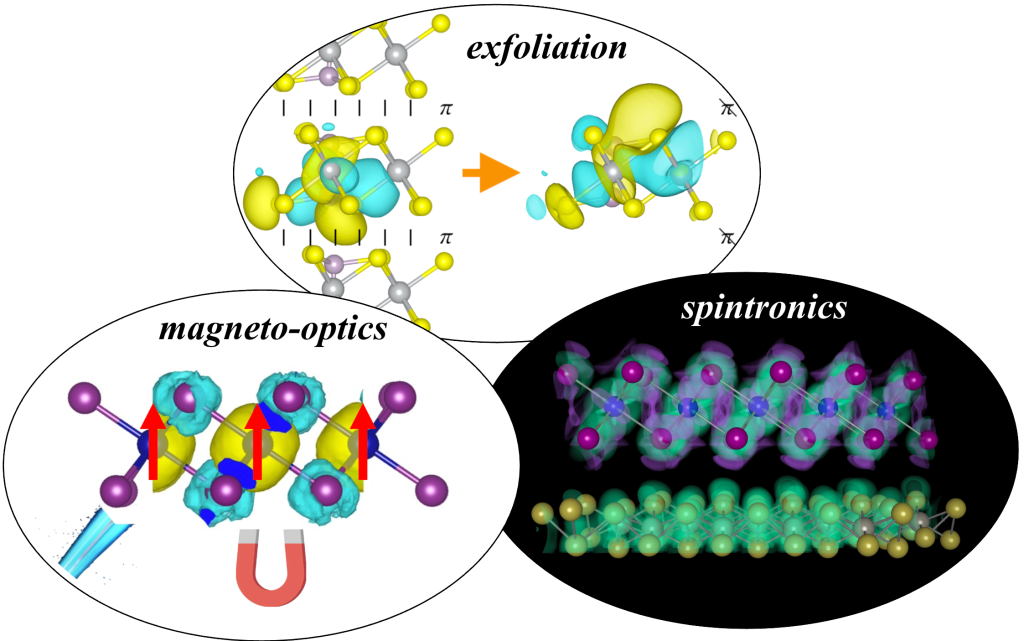
- Showing that strong electron correlation can degrade integer quantum Hall conductivity (arXiv Preprint, 2026),
- Calculating the many-body fundamental gap of the correlated 2D magnet, monolayer CrI3 (npj 2D Mater. Appl., 2026),
- Proposing a new correlated, topological 2D material and possible mechanism for filtering electron spin in the absence of an external field (npj Spintronics, 2025),
- Explaining why the exfoliation of thin-layers of the correlated material NiPS3 changes the measured X-ray spectrum (Advanced Physics Research, 2024), and
- Predicting the accurate crystal structure of monolayer CrI3 which agreed with a subsequent experimental measurement to within 0.5%, compared to a 10% spread across previous DFT predictions (Journal of Chemical Physics, 2022).
II. Nuclear Forensics (theoretical support)
Nuclear forensics, the forensic science underlying examination of nuclear reactor fuel and other radioactive materials, plays a key role in thwarting illegal trafficking of nuclear materials. At ORNL, LLNL, and now LANL, I have contributed to nuclear forensics missions by:
- Performing programmatic nuclear forensics work (Report in preparation, 2026),
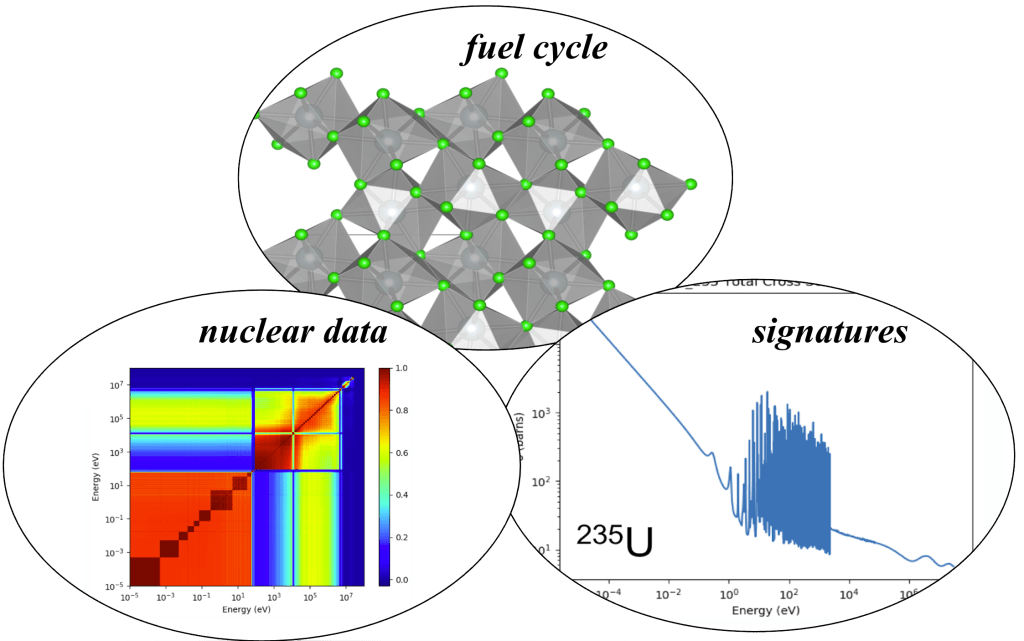
- Machine-learning possible compositions of oxidized and fluorinated uranium materials and their energetic stabilities – e.g. their likelihood to exist in nuclear reactor fuels – and corresponding experimental signatures (Submitted to J. Nucl. Mater., 2026; J. Phys. Chem. C, 2019), and
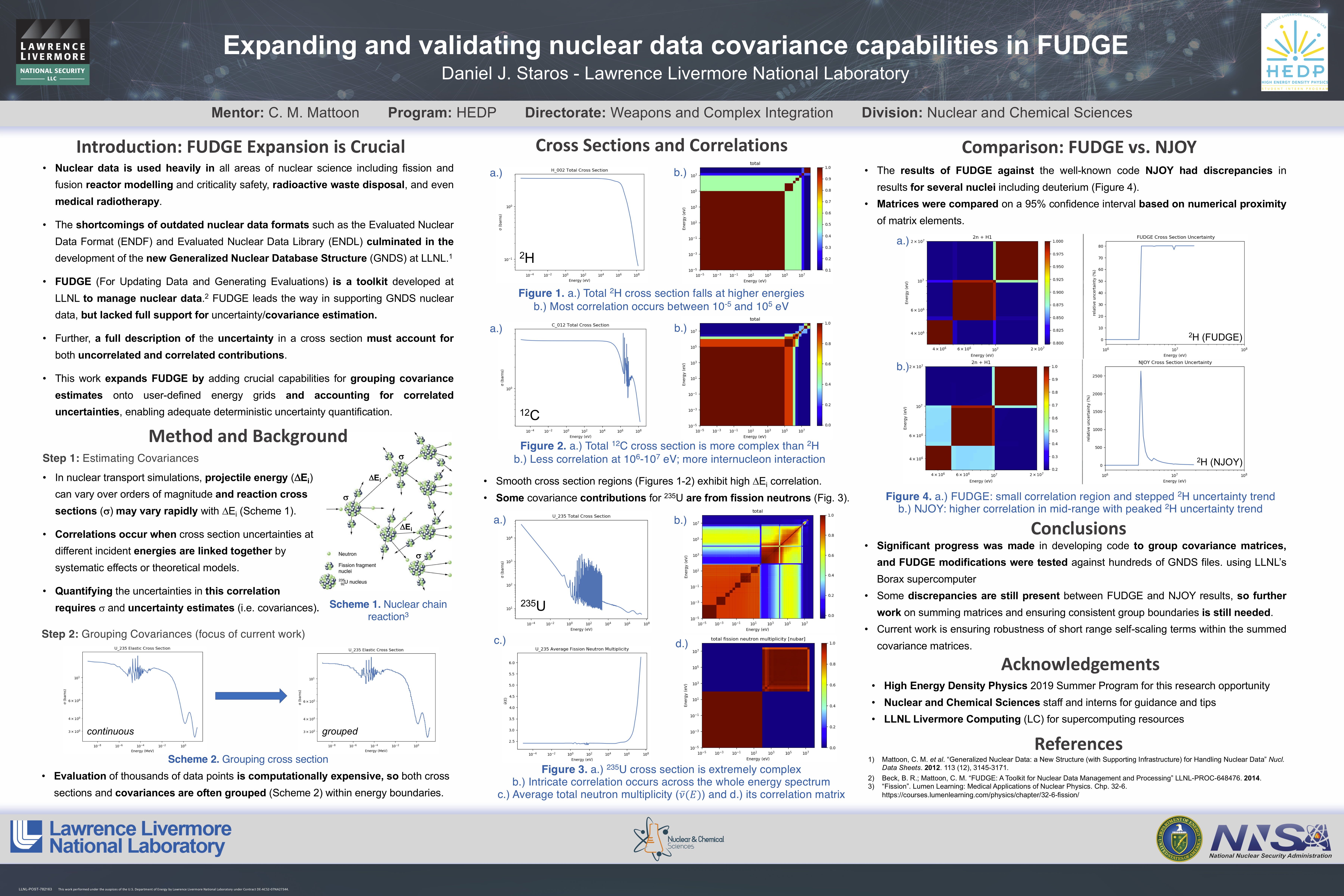
- Co-developing capabilities for the LLNL code FUDGE to improve the manipulation of statistical uncertainties in GNDS nuclear data, and thus numerical treatment of nuclear signatures (LLNL-POST-782163).
III. Computational Physics
In addition to the scientific thrusts above, I have also contributed research that focuses more on improving the numerical methods and computations used to understand chemical and physical systems, rather than solely on the understanding itself. In this vein, I have:
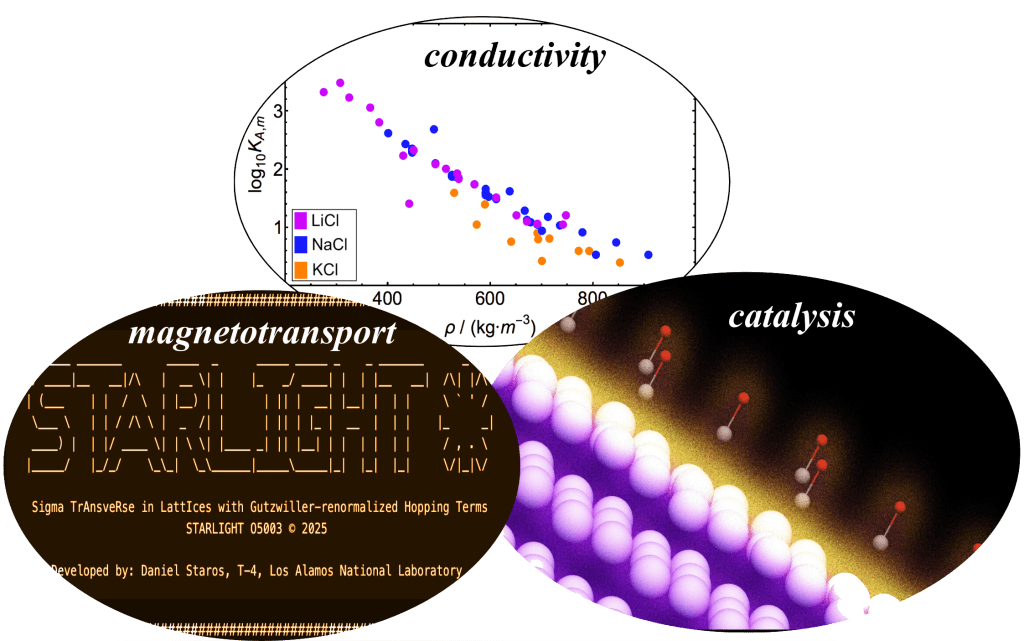
- Built a Python program that solves for the ground state and predicts magneto-transport of correlated 2D lattices (STARLIGHT, GitHub, 2025),
- Benchmarked self-consistent convolutional density functional approximations by performing supporting quantum Monte Carlo calculations (ChemPhysChem, 2024), and
- Programmed and compared nonlinear regression models of experimental hydrothermal conductivity data, enabling accurate calculation of transport coefficients (J. Chem. Eng. Data, 2022).
 Daniel J. Staros